
Article: A Guide to Bottles of Ink for Fountain Pens: Colour and Care
A Guide to Bottles of Ink for Fountain Pens: Colour and Care
Choosing from the vast array of bottles of ink for fountain pen is the first step in a rewarding ritual, one that connects you to your instrument and your words in a way disposable cartridges never could. This choice is about more than just function; it is an essential part of your personal expression, a quiet act of craftsmanship.
The Enduring Appeal of Bottled Fountain Pen Ink

The decision to use bottled ink is a deliberate one. It signals a deeper appreciation for the art of writing and a conscious step away from the convenience of disposability. The simple act of uncapping a bottle, breathing in the faint, unique scent of the ink, and carefully drawing it into a pen becomes a meditative practice. This ritual prepares the mind for the thoughtful process of putting words to paper.
This preference is also rooted in a number of practical advantages. Much like iconic perfumes, understanding the enduring appeal of bottled liquids reveals something about cultural value and personal connection. For the fountain pen enthusiast, a bottle of ink represents a world of possibility.
A Superior Writing Experience
The principal reason writers choose bottled ink is the sheer variety and quality available. Beyond the limited selection of pre-filled cartridges, the world of bottled ink offers an almost infinite palette of colours, shades, and properties. It allows you to perfectly match your ink to your mood, purpose, or even the paper you are using.
The connection between a writer and their tools is deepened through the ritual of care. Filling a pen from a bottle is not a chore but a moment of quiet contemplation, strengthening the bond with the instrument that will translate thought into tangible form.
This choice also brings tangible improvements to the act of writing itself. The superior formulation of many bottled inks, such as those from Scriveiner, ensures a smooth, consistent flow that enhances the performance of a fine nib.
The Benefits of Tradition
Embracing bottled ink over cartridges offers a range of compelling advantages for any fountain pen user. These benefits extend beyond aesthetics to include economy and environmental responsibility.
- Expansive Colour Selection: You gain access to thousands of unique hues from artisan ink makers around the globe, allowing for unparalleled personal expression.
- Greater Economic Value: A single bottle contains far more ink than dozens of cartridges, offering a much lower cost per millilitre over time.
- Reduced Environmental Impact: By refilling your pen from a bottle, you eliminate the single-use plastic waste associated with disposable cartridges.
- Enhanced Performance: Many high-quality bottled inks are formulated to provide superior flow, shading, and sheening characteristics, elevating the writing experience.
Understanding the Foundation of Fountain Pen Inks
To truly appreciate the art of penmanship, one must look beyond the pen itself and into the very soul of writing—the ink. The chemistry inside each bottle dictates how your words appear on the page, how your pen glides, and how long your thoughts will endure. Selecting from the endless array of bottles of ink for fountain pen becomes a much richer experience when you understand what makes each one unique.
At its core, fountain pen ink is a simple blend: a solvent (usually purified water) and a colourant. The nature of that colourant, however, divides inks into three main families, each with its own personality and characteristics. Familiarising yourself with these types is the first step in finding the perfect ink for your Scriveiner pen.
The Versatility of Dye-Based Inks
Dye-based inks are the stalwarts of the fountain pen world, and for good reason. The colourant, a collection of chemical compounds, dissolves completely into the water, creating a smooth, free-flowing liquid that moves effortlessly through the intricate channels of a pen's feed.
This results in wonderfully vibrant, often translucent inks that come in a breathtaking spectrum of colours. Furthermore, they are exceptionally easy to clean from a pen. Their simple composition makes them a safe choice for almost any fountain pen, significantly reducing the risk of clogs. It is this low-maintenance nature that makes dye-based inks an ideal starting point for newcomers and a reliable staple for seasoned writers.
For a deeper exploration of inks and their properties, you may be interested in our complete guide, which expands on these concepts. This resource can help you learn more about the nuances of fountain pen ink and make more informed choices for your collection.
The Permanence of Pigment-Based Inks
While dye-based inks dissolve, pigment-based inks suspend. They contain microscopic solid particles of colour that float in the liquid rather than dissolving into it. Once this ink dries on paper, those tiny particles lock onto the fibres, creating a mark that is permanent, lightfast, and resistant to water.
This permanence makes pigment inks the superior choice for archival work, signing important documents, or for artists who wish to apply a watercolour wash over their linework without smudging. However, this resilience requires greater responsibility from the user.
Because the colour is derived from solid particles, they can settle inside a pen's feed if it is left unused. Diligent, regular cleaning is essential to prevent clogs and keep your writing instrument in optimal condition.
The Tradition of Iron Gall Inks
Iron gall inks are among the most ancient formulas, with a history stretching back over a thousand years. These traditional inks are made from a mixture of iron salts and tannic acids. Their most fascinating quality is their reaction with the air.
When you first write with an iron gall ink, it often appears quite pale. As it dries and oxidises, it darkens into a deep, permanent black or blue-black. This chemical reaction essentially etches the ink into the paper fibres, making it incredibly durable. Modern formulations are much gentler than their historical counterparts, yet they remain mildly acidic. This simply means that good pen hygiene is key to protecting your pen’s internal components over time.
To help you decide, let us break down the key differences in a simple table.
A Comparative Overview of Fountain Pen Ink Types
This table compares the primary types of fountain pen ink, highlighting their key characteristics, ideal uses, and maintenance needs to help you select the perfect ink.
| Ink Type | Primary Characteristic | Best Suited For | Pen Care Requirement |
|---|---|---|---|
| Dye-Based | Colourant dissolves completely in water | Everyday writing, journaling, exploring a wide range of colours | Low. Easy to clean, very pen-friendly. |
| Pigment-Based | Microscopic solid particles suspended in liquid | Archival use, artwork, signing documents where permanence is key | High. Requires frequent and thorough cleaning to prevent clogs. |
| Iron Gall | Oxidises on paper to become permanent and dark | Formal documents, historical writing styles, users wanting permanence | Medium. Requires regular cleaning due to its acidic nature. |
Ultimately, the best ink is the one that fits your writing style and the pen you love to use. Experimentation is part of the pleasure of this pursuit.
Exploring the Nuances of Ink Colour and Properties
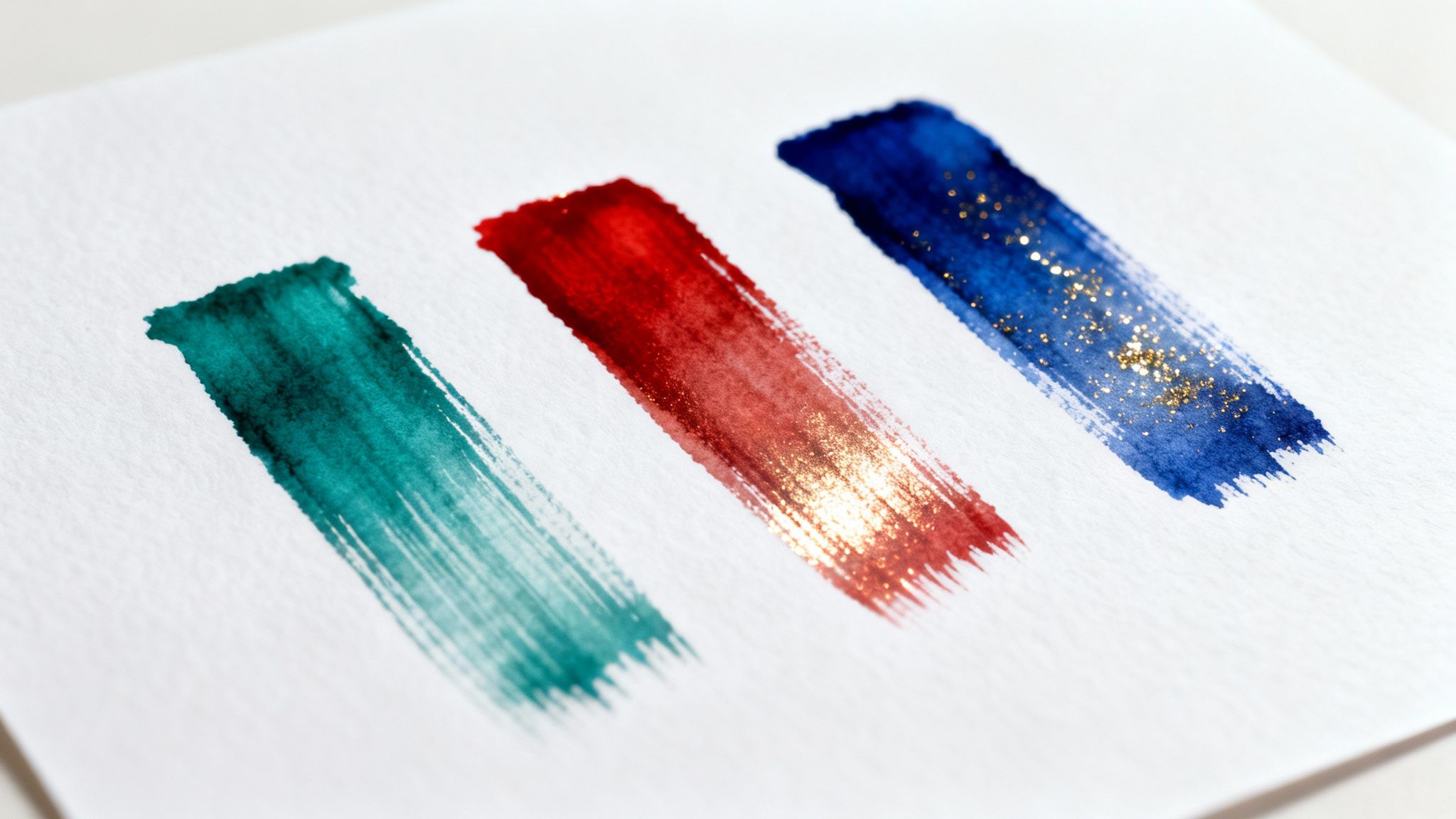
While the immediate draw of a new ink is its colour, the true character of that ink is revealed in its behaviour on the page. Beyond simple hue, a world of subtle properties defines the writing experience, turning a simple act into something much more personal. Understanding these characteristics is the key to appreciating the full depth that bottles of ink for fountain pen can offer.
These are the properties that ink connoisseurs discuss and celebrate. They are the details that bring your handwriting to life, adding dimension and personality to every word you write. Learning to identify them will not only refine your own taste but also help you pair the perfect ink with the right pen and paper for any given task.
The Art of Shading
One of the most sought-after qualities in fountain pen ink is shading. This is the elegant variation in colour density that appears within a single letter or stroke. Where the ink pools, such as at the end of a line, the colour appears deep and concentrated. Where the nib has moved more swiftly, the colour is lighter and almost translucent.
This effect creates a beautiful, subtle gradient that gives handwriting a sense of depth and dimension. It is most noticeable with broader nibs and on high-quality, less absorbent paper that allows the ink to sit on the surface momentarily before drying. An ink with good shading transforms flat script into something dynamic and visually engaging.
The Surprise of Sheen
Have you ever tilted a page to the light and noticed a metallic lustre on the ink, often in a colour different from the ink itself? This captivating effect is known as sheen. It occurs when a highly saturated ink dries on the surface of non-absorbent paper, causing some of the dye to crystallise.
For example, a deep blue ink might reveal a coppery red sheen, or a dark red might flash with a brilliant gold. This is not glitter; it is purely a property of the ink's chemistry. Sheen is a delightful surprise that adds a layer of complexity to your writing, making certain inks feel truly special.
The Sparkle of Shimmer
For those who desire a more overt sparkle, there are shimmer inks. These inks contain fine, non-reactive metallic particles—like gold, silver, or bronze—suspended within the liquid. As you write, these particles are distributed across the page, catching the light and creating a gentle, glittering effect.
Shimmer inks are a testament to the creativity within the ink world, offering a way to add a celebratory touch to correspondence, journal entries, or creative projects. They invite a moment of playfulness into the otherwise serious art of penmanship.
It is important to note that because of the suspended particles, shimmer inks require more diligent pen maintenance to prevent the feed from clogging. Regular and thorough cleaning is the key to enjoying these dazzling inks without issue.
Practical Ink Properties
Beyond these aesthetic qualities, several practical characteristics determine how an ink feels in use. These properties have a direct impact on your pen’s performance and the final appearance of your script.
- Flow (Wet vs. Dry): This describes how generously an ink flows from the nib. A 'wet' ink provides a lubricated, smooth feel and lays down a broad, saturated line, while a 'dry' ink offers more resistance and a finer line.
- Saturation: This refers to the intensity and concentration of the colour. A highly saturated ink appears bold and uniform, whereas a less saturated ink is more likely to exhibit beautiful shading.
- Drying Time: The time it takes for ink to dry on the page is a critical factor, especially for left-handed writers or for rapid note-taking. This is influenced by the ink's formula, the paper's absorbency, and the wetness of the pen.
Mastering this vocabulary allows you to move beyond simply choosing a colour. You can now select an ink based on its personality—whether you seek the subtle depth of a shading ink, the hidden lustre of a sheening one, or the practical reliability of a quick-drying formula.
How to Select and Preserve Your Ink Collection
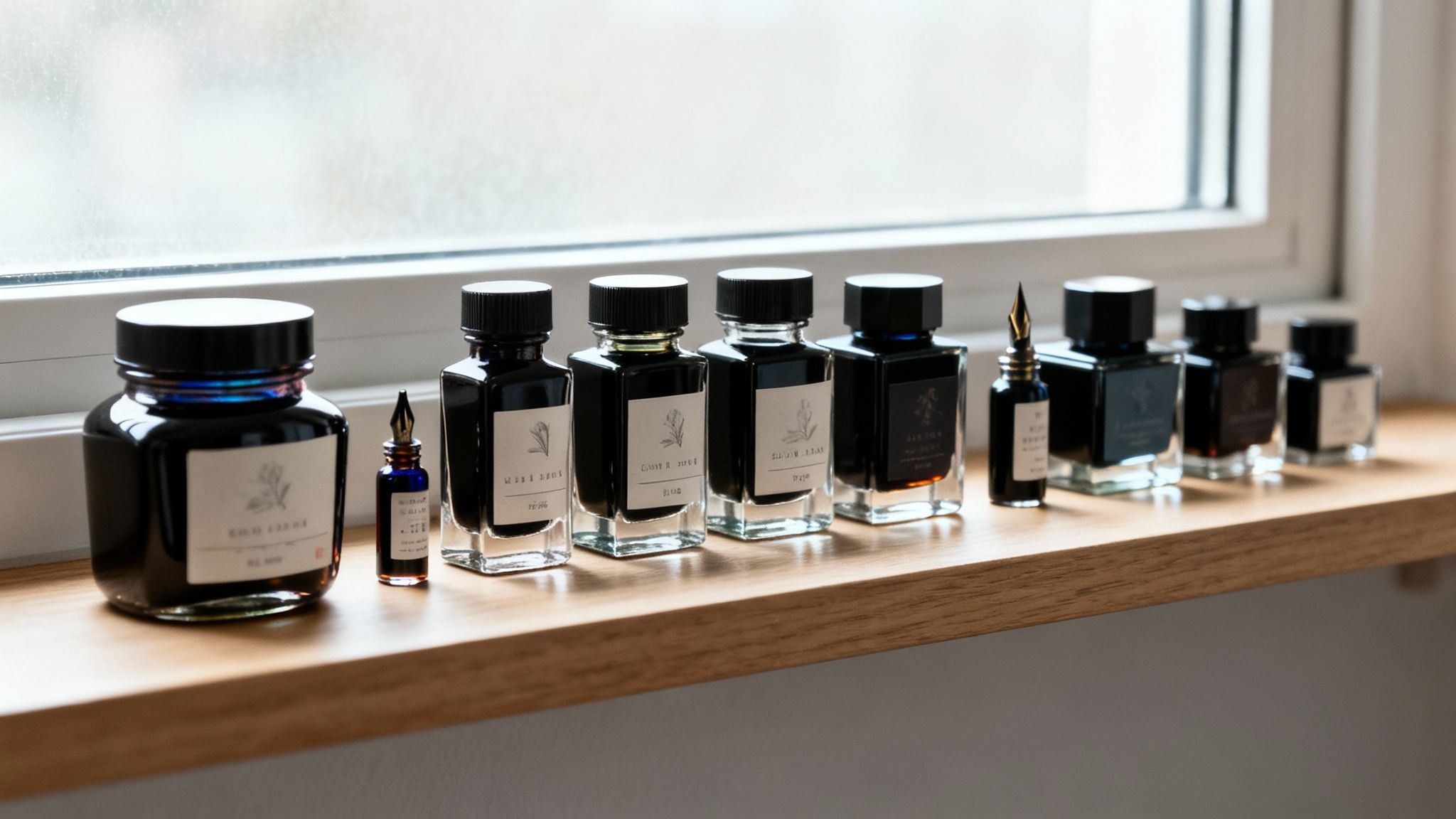
Curating a collection of inks is one of the most personal joys of using a fountain pen. Each bottle holds more than just a colour; it holds a potential mood, a future project, or a new voice for your thoughts. Building this library, however, is a quiet art that blends personal taste with practical knowledge.
The journey often begins not with the ink itself, but with its vessel. An ink bottle’s design is far more than an aesthetic choice—it is a crucial part of its function. A well-designed bottle makes the ritual of filling your pen a clean and effortless pleasure.
The Practicality of Bottle Design
When choosing bottles of ink for fountain pen use, consider the opening. A wide-mouthed jar provides ample room to manoeuvre a nib and converter without difficulty, transforming a delicate operation into a confident, straightforward task.
Conversely, some bottles are designed with elegance or compactness in mind. Smaller, more ornate containers are perfect for travel or for those with limited desk space. They may require more care during filling—sometimes even a blunt syringe for the last few millilitres—but for many, their form is part of their charm.
The bottle is the gateway to the ink within. A design that balances beauty with function respects the writer's time and enhances the overall experience, ensuring that every interaction with your collection is a positive one.
Volume is another key factor. While a large 60ml bottle offers excellent value, it is also a long-term commitment to a single colour. Considering a typical 50ml bottle can provide around 50 refills, it might serve you for years. If you are still exploring your palette, smaller 30ml bottles or sample vials are a wonderful way to experiment without committing to a large quantity.
Building Your Collection Thoughtfully
It is easy to become captivated by every new shade in the vast world of inks. A more measured approach will help you build a collection that is both inspiring and manageable. Consider organising your choices around a few core ideas.
- Start with Staples: Begin with a few versatile, high-quality colours that suit your daily writing—a classic blue, a professional black, and perhaps a rich brown or a deep green.
- Explore by Property: Once your foundations are in place, branch out by looking for specific ink properties. You might seek an ink with exceptional shading, a surprising sheen, or even a subtle shimmer.
- Consider Your Instruments: Some inks perform better in certain pens. A dry ink can tame a wet-writing, broad-nibbed pen, while a wet, lubricating ink can make a fine nib glide across the page.
This growing interest in speciality inks is clear in wider market trends. In the UK, for instance, the consumption of non-printing inks—the category these fine writing fluids fall into—recently reached approximately 6,000 tons. This figure is on the rise, with the market forecast to grow substantially, highlighting the strength of the enthusiast community. You can find more insights into the UK's dynamic ink market on IndexBox.
Preserving the Integrity of Your Inks
An ink collection is an investment that, with the right care, will last for decades. The main adversaries of bottled ink are light, air, and extreme temperatures. Fortunately, protecting your collection is simple.
The most critical rule is to store your inks away from direct sunlight. UV rays can degrade the chemical compounds that give an ink its colour, causing vibrant hues to fade. A cool, dark place like a desk drawer, a cabinet, or the original box is ideal. Storing your pens properly is just as important; take a look at our guide on how to correctly store your fountain pens to ensure they are well-maintained.
Always ensure the bottle cap is screwed on tightly after each use. This simple habit prevents two problems: evaporation, which can thicken the ink and alter its properties, and contamination from airborne dust or mould spores. By following these straightforward practices, you ensure every bottle in your collection remains as brilliant as the day you first opened it.
Mastering the Ritual of Pen Filling and Maintenance
Filling and cleaning a fountain pen are not chores; they are small, quiet rituals. They mark a moment of connection between you, your pen, and the ink that will soon bring your thoughts to life. Practiced correctly, these habits do not just keep your pen working—they enhance the entire experience of writing.
The act of filling a pen from a bottle is one of care. It begins with selecting from your collection of bottles of ink for fountain pen and setting up a clean, steady surface. This is not about being fastidious; it is about being mindful, ensuring each step is performed with gentle confidence.
The Principles of a Perfect Fill
Whether your pen has a converter or a piston mechanism, the objective is the same: to draw ink smoothly into the reservoir, ensuring the feed is fully saturated without any trapped air. A crucial first step is to submerge the entire nib, and even a small part of the grip section, into the ink. This allows the feed to soak completely, preparing it to deliver a consistent line from the very first stroke.
A frequently overlooked detail is what to do after filling. Point the nib upwards and expel two or three drops of ink back into the bottle. This small action serves a significant purpose: it pushes out any trapped air and prevents the feed from being oversaturated, thus avoiding frustrating drips and blots when you begin to write.
The art of filling a pen is a dialogue between writer and instrument. It is a moment of preparation that promises an uninterrupted flow of thought, ensuring the pen is ready to perform at its peak the moment it touches the page.
If you would like a more detailed guide, our article on how to master the art of refilling your fountain pen breaks down the entire process.
The Importance of Pen Hygiene
Just as a proper fill sets you up for a great writing session, regular cleaning is the key to your pen's longevity. Over time, components in the ink—especially in saturated or specialised formulas—can dry and accumulate inside the tiny, delicate channels of the feed. This residue is what causes inconsistent flow, hard starts, or even a complete clog.
Therefore, regular cleaning is not merely a suggestion; it is essential. A simple flush with cool, clean water every few weeks, or whenever you change ink colours, is usually all it takes to keep your pen in optimal condition. It is a simple habit that ensures every new ink you try is seen in its truest, most vibrant form, free from the remnants of colours past.
This move towards refillable pens is a growing trend. In the UK, there is a strong preference for bottled inks, which are valued for their versatility and for being a more sustainable choice. The larger volumes in bottles of ink for fountain pen use appeal to those who write often, while the shift away from disposable plastic cartridges is part of a wider move towards sustainability.
By embracing these rituals of filling and maintenance, you are not just looking after a tool. You are participating in a tradition, ensuring your fine writing instrument remains a reliable and elegant companion for years to come.
Troubleshooting Common Fountain Pen Ink Issues
Even the finest pens can have moments of difficulty. Suddenly, what should be a smooth, joyful experience becomes a frustrating engagement with your own tools. Fortunately, most ink problems are surprisingly simple to resolve. They usually come down to a slight imbalance between the ink, the paper, and the pen itself.
One of the most common complaints is about feathering. This occurs when your ink spreads out on the page, creating fuzzy, blurry lines instead of crisp ones. In most cases, this is a simple mismatch. A very 'wet' ink on a highly absorbent paper is the classic recipe for a feathered line. The solution is straightforward: either try a 'drier' ink or switch to a higher-quality, less absorbent paper that allows the ink to sit on the surface where it belongs.
This decision tree provides a straightforward path for diagnosing what is happening.
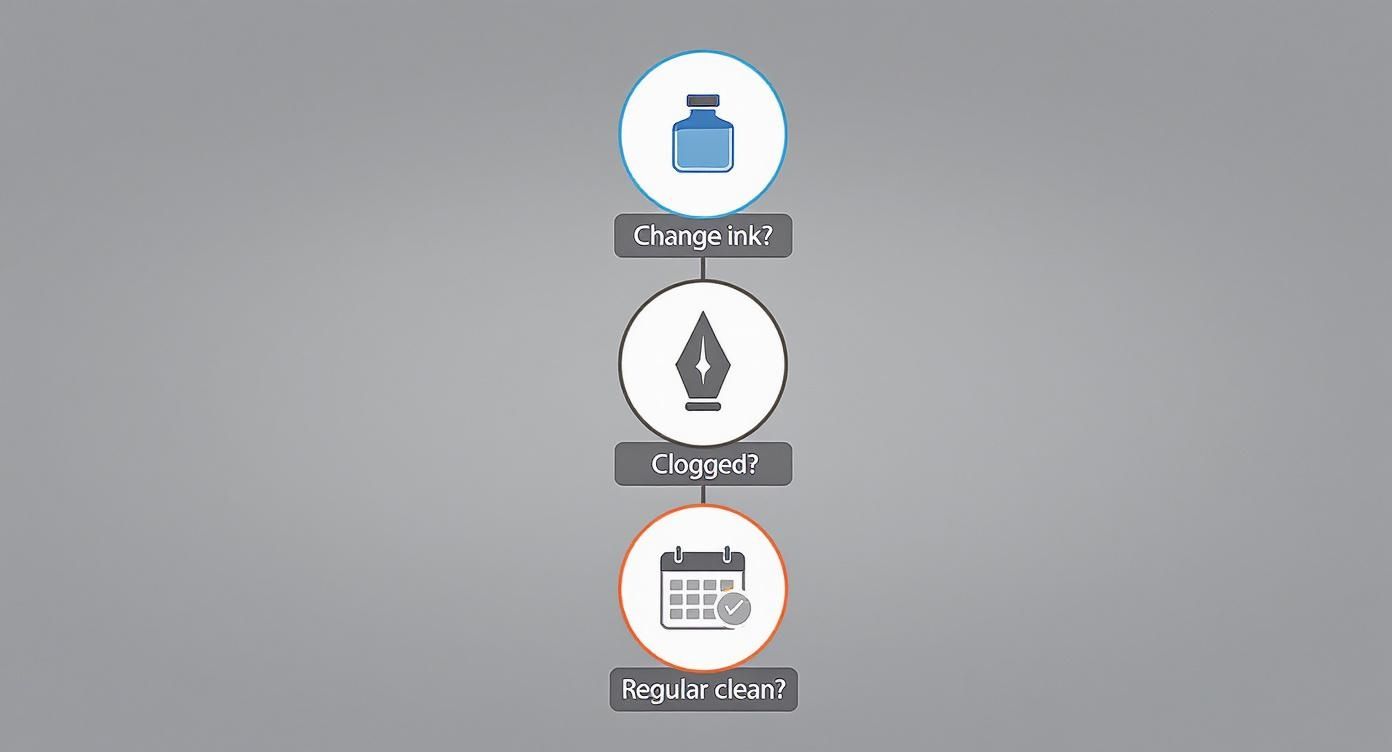
As you can see, a logical approach solves most problems. Begin by considering your ink, then check for clogs, and remember that regular care is your best defence.
Addressing Flow and Clogging Problems
When a pen fails to write (hard starts) or the line keeps breaking up (skipping), you have an ink flow problem. It could be that the feed is somewhat dry, or perhaps the ink is not interacting well with that particular pen. The most severe issue is a complete clog, which is a real risk with pigment or shimmer inks if you allow the pen to sit unused for too long. Those tiny solid particles can settle in the feed’s delicate channels and bring everything to a halt.
For nearly every flow-related issue, the first and best remedy is a thorough cleaning. Often, a simple flush with cool water is all it takes to dissolve dried ink and get your pen writing beautifully again.
Adopting a habit of regular maintenance is fundamental to the fountain pen experience. It is a small investment of your time that protects your pens and ensures they are always ready when inspiration strikes. It is what makes using even the most adventurous inks a pleasure.
Speaking of ink, you might be surprised by how long a bottle lasts. Data from UK enthusiasts shows a typical 50ml bottle provides about 50 refills, which can add up to around 1,000 pages of writing. This helps explain why collections tend to grow; each bottle is a long-term companion. You can read more about the habits of UK fountain pen users on UK Fountain Pens.
By calmly diagnosing the issue—whether it is feathering, skipping, or a clog—you can make simple adjustments and return to the pure joy of writing.
Common Questions About Fountain Pen Ink
Engaging with bottled ink, whether you are just beginning or have been doing so for years, always brings up a few questions. Let us clarify some of the most common ones.
How Many Fills Can I Get From One Bottle?
A standard 50ml bottle of ink goes a surprisingly long way. For a pen using a typical international converter, you can expect to get around 50 full refills. Since each fill often lasts for many pages of writing, a single bottle is a fantastic investment that can keep you writing for a very long time.
Can I Mix Different Inks Together?
While it might seem like an inventive way to create a unique shade, mixing inks is something we generally advise against. This is especially true when mixing different brands or even different ink lines from the same maker.
Every ink has its own complex chemical formula. When you combine them, you risk an unpredictable reaction that could lead to clogs, stained feeds, or even permanent damage to your pen. If you are keen on customisation, a much safer approach is to use shimmer additives made specifically for fountain pen inks or to purchase from brands that specialise in creating custom colours.
Is It Safe to Use Old Fountain Pen Ink?
Absolutely, provided it has been stored properly. High-quality ink can easily last for decades. Before you fill a beloved pen, however, it is wise to give the bottle a quick inspection. Check for any unusual changes in colour, smell, or viscosity.
The biggest concern with old ink is what collectors call SITB, or "slime in the bottle." This is essentially a mould-like growth. If you observe any substance that will not reintegrate into the ink or detect a strange odour, it is best to discard the bottle. It is simply not worth risking your pens.
What’s the Best Way to Try New Inks?
Without a doubt, the best way to explore the endless world of bottles of ink for fountain pen use is with ink samples. Many retailers sell small 2-5ml vials, which is just enough to test a colour in your favourite pen and see how it behaves on your paper. This allows you to check its flow, drying time, and true colour without having to commit to a full bottle.
This approach saves you both money and shelf space. It is the perfect way to build a collection of colours you truly love and discover the next favourite shade for your Scriveiner pen.
Discover the perfect ink to bring your words to life. Explore the curated collection of premium Scriveiner inks and find the ideal companion for your finest writing instruments at https://www.scriveiner.com.


Leave a comment
This site is protected by hCaptcha and the hCaptcha Privacy Policy and Terms of Service apply.