
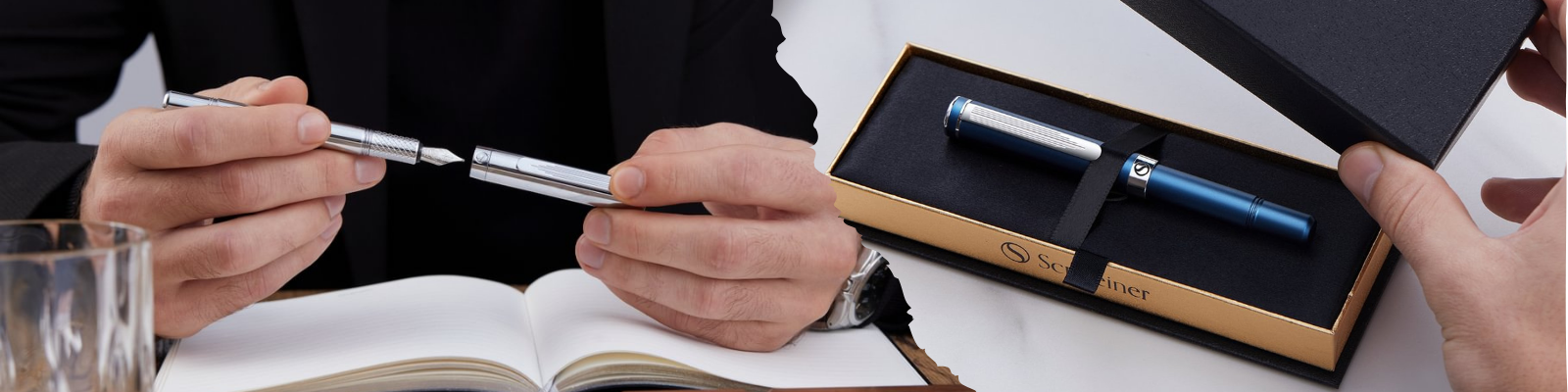
A Guide to Fountain Pen Nibs: Understanding the Heart of Your Pen
Every journey into the world of fountain pens begins with one small, crucial component: the nib. This piece of metal is the heart of the pen, the point where your thoughts are translated into flowing, elegant script. It is what defines the pen's character and performance from the very first stroke.
The Soul of the Pen: An Introduction to the Nib
To appreciate a fountain pen is to appreciate its nib. It is far more than a simple point; it is a precisely engineered tool designed to manage the delicate flow of ink from the pen’s reservoir to the paper. Consider it a conductor's baton, orchestrating the movement of ink with grace and precision to create a line that is uniquely yours.
Your choice of nib has a profound effect not just on the appearance of your handwriting, but on the tactile pleasure of writing itself. A well-made nib glides across the page, providing a smooth, controlled sensation that turns writing from a task into a moment of mindful expression. This intimate connection between writer, pen, and paper is what draws so many to the art of penmanship.
Defining Your Penmanship Experience
The specific qualities of a fountain pen nib — its material, its size, its shape — directly inform the script that appears on the page. This relationship between the tool and the result is at the centre of the fountain pen’s enduring appeal. A writer can choose a nib that perfectly suits their personal style, whether that means producing fine, delicate lines for detailed notes or broad, expressive strokes for personal correspondence.
The beauty of a Scriveiner fountain pen lies in this very principle. Each is designed to provide an exceptional writing journey, with a nib that serves as the perfect starting point. The quality of this single component can transform your relationship with writing, fostering a deeper appreciation for the craft.
A quality fountain pen nib does not merely write; it communicates. It channels your intent, giving your words a physical presence and character that cannot be replicated by other means.
What You Will Discover
This guide will demystify the world of fountain pen nibs, providing the knowledge to make an informed choice. We will explore the key areas to build your expertise:
- Anatomy and Materials: We'll examine the intricate parts of a nib and explore how materials like steel and gold affect its performance.
- Sizes and Grinds: You will learn how different nib sizes, from Extra-Fine to Broad, and specialised grinds can shape your handwriting.
- Care and Maintenance: We will cover the essential practices for keeping your nib in perfect condition for a lifetime of use.
By understanding the nib, you unlock the full potential of your fountain pen. Consider this your starting point for a deeper exploration, one that will prepare you to select a writing instrument that feels like a true extension of your own hand.
Understanding the Anatomy of a Nib
To truly know a fountain pen, one must begin with its heart: the nib. It may appear as a simple piece of metal, but that small point is a marvel of precise engineering. Each part works in perfect harmony to lay down a smooth, controlled line of ink. To think of it as just a 'tip' overlooks the sheer craft that makes an exceptional writing experience possible.
At its core, a nib functions using a physical principle called capillary action. This is what draws ink from the pen’s reservoir, down a minuscule channel, and onto the paper in a steady, measured flow. It is a delicate process governed by a few key features, and understanding them provides a new appreciation for the instrument in your hand.
The Key Working Parts
When you look closely at a nib, you will first notice the tines — the two halves that form the very front, separated by a hair’s breadth. For a pen to write smoothly, these tines must be perfectly aligned and symmetrical. If they are even a fraction of a millimetre misaligned, it will be felt as scratchiness or seen as an inconsistent line on the page.
Running down the centre is the slit, the narrow channel that separates the tines. This is the ink's pathway. The slit is cut with incredible precision; it needs to be just wide enough for ink to flow but not so wide that it floods the paper. The exactness of this cut directly shapes how 'wet' or 'dry' a pen writes.
The relationship between the tines and the slit gives a nib its character. It not only manages ink flow but also dictates the nib's flexibility, allowing for beautiful variations in line width as you write.
Toward the top of the slit, you will usually see a small, round opening called the breather hole. Its original function in dip pens was to relieve stress during manufacturing and prevent the metal from cracking. Today, its role is just as vital. It acts as an air exchange, regulating the pressure inside the pen to keep ink flowing consistently without skips or sudden blobs of ink.
The Point of Contact
Finally, we come to the part that meets the paper: the tipping material. On any quality fountain pen, the very tip of the nib is welded with a tiny ball of an incredibly hard-wearing alloy, typically from the iridium family. This material is exceptionally durable, built to withstand years of friction against paper without wearing down.
This small ball is then ground and polished into a specific shape and size, which ultimately defines the line your pen creates—whether a delicate Extra-Fine, a versatile Medium, or a bold Broad. The quality of the tipping material and the skill used to shape it are what make a nib feel truly smooth. It is the final, critical touch that turns a simple piece of metal into a refined instrument for expression.
To bring it all together, here is a summary of these essential components.
Key Components of a Fountain Pen Nib
The table below breaks down the primary parts of a nib, explaining what each one does and how it affects your writing experience.
| Component | Function | Impact on Writing |
|---|---|---|
| Tines | The two halves that form the tip of the nib. | Determines smoothness through precise alignment and allows for line variation through flexibility. |
| Slit | The very fine cut that separates the tines. | Acts as the primary channel for ink flow, controlling how 'wet' or 'dry' the pen writes. |
| Breather Hole | The small hole at the end of the slit. | Regulates air pressure, ensuring a consistent and uninterrupted flow of ink to the tines. |
| Tipping Material | The hard alloy welded to the end of the tines. | Creates the smooth writing point, defining the nib size and ensuring long-term durability. |
Each element plays a crucial role. From the flow regulated by the slit to the feel shaped by the tipping, these parts work in concert to create the unique character of your pen.
How Nib Materials Shape Your Writing Experience
Choosing a nib material is about more than aesthetics; it is about how the pen feels in your hand and the character it imparts to your writing. The metal dictates the pen's personality — its feel against the page, its durability, and the subtle ways it responds to your touch. This is where you begin to tailor the writing experience to your own style.
In the world of modern pens, two materials dominate: stainless steel and gold. Each has a distinct character that appeals to different writers, and understanding them is key to finding a pen that feels personally suited to you.

This diagram shows the essential parts of a nib — the tines, slit, and breather hole. Together, these elements work with the metal to create a controlled and satisfying flow of ink to paper.
The Reliable Strength of Stainless Steel
Stainless steel is the workhorse of the fountain pen world. It is known for being firm, resilient, and incredibly durable. A steel nib provides a consistent, controlled line, making it an excellent choice for everyday use, whether you are taking notes, journaling, or writing at work.
Most steel nibs have very little flex, meaning the tines do not spread significantly under pressure. This creates a uniform line, perfect for writers who value precision and predictability. This rigidity also makes them tough enough to handle fast writing and less-than-perfect paper with ease.
Historically, steel transformed the industry. In the 19th century, Birmingham became the world's hub for steel pen nibs. By the mid-1800s, it was producing over half of the world’s supply. This made writing affordable for the general populace and had a significant impact on literacy.
The Refined Elegance of Gold
Gold nibs are treasured for the unique feeling they provide. While not all are "flex" nibs, gold possesses a natural softness that gives a more cushioned, responsive feel on the page. This subtle give adapts to your hand, creating a writing experience that feels uniquely personal.
The most common alloys are 14-carat and 18-carat gold, as pure 24-carat gold would be too soft for a durable writing tip. This softness allows the nib to absorb minuscule vibrations as it moves, resulting in what many describe as a smoother, more luxurious glide. This is why gold nibs are often preferred for long writing sessions — they can help reduce hand fatigue.
The real magic of a gold nib is its responsive nature. It doesn’t just write; it communicates with you, offering feedback that connects you more deeply to the words you’re forming.
Understanding Finishes and Plating
Beyond the base metal, many nibs feature finishes that add both style and function.
- Gold-Plating: Steel nibs are often plated with a thin layer of gold. This gives them the luxurious look of solid gold while retaining the firm feel and affordability of steel.
- Two-Tone Nibs: Many premium pens feature two-tone nibs. Here, parts of a gold nib are masked and plated with a silver-coloured metal like rhodium, creating a stunning visual contrast that also enhances corrosion resistance.
These finishes marry performance with style. Scriveiner pens, for example, often use beautifully finished Schmidt nibs that blend reliable German engineering with a sophisticated look. You can find more details in our guide on materials used in Scriveiner pens.
Ultimately, whether you lean towards the steadfast consistency of steel or the gentle response of gold, the material of your nib is a deeply personal choice that will shape every word you write.
Finding the Perfect Nib Size and Grind for Your Style

Choosing a nib size is perhaps the most personal decision you will make when selecting a fountain pen. It is the single element that translates your unique handwriting onto the page, shaping its character and presence. The range of available fountain pens nibs offers the opportunity to find a point that does not just suit your script, but truly elevates it.
The choice is not merely about how your writing looks; it profoundly affects how writing feels. A finer nib might provide more precise, tactile feedback from the paper, while a broader nib often glides across the page with a distinct, fluid smoothness. It is all about matching the tool to your purpose, your style, and even the paper you are using.
The Spectrum of Standard Nib Sizes
Standard nibs are categorised by the width of the line they produce, from the most delicate to the boldest. Each size has its own personality and is suited to different tasks and handwriting. Understanding these distinctions is the first step toward finding your ideal writing companion.
A Medium (M) nib is often considered the versatile middle ground. It offers a pleasing balance of smoothness and line definition that suits most writers and papers, making it a reliable starting point for anyone new to fine writing. You can explore some excellent options in our guide to the best fountain pens for beginners, which often feature these well-rounded nibs.
For those with smaller, more compact handwriting, an Extra-Fine (EF) or Fine (F) nib is an excellent choice. These nibs lay down a crisp, slender line, perfect for detailed notes, journaling in smaller notebooks, or writing on paper that might be prone to feathering.
Conversely, writers with larger, more expressive handwriting often gravitate towards Broad (B) or Double-Broad (BB) nibs. These generous points produce a rich, wet line that showcases the shading and sheen of an ink beautifully. They require high-quality paper to perform at their best, but they reward the user with a luxurious and bold writing experience.
To help you visualise the differences, here is a quick overview of the most common nib sizes and their ideal applications.
Common Fountain Pen Nib Sizes and Their Characteristics
| Nib Size (e.g., EF, F, M, B) | Writing Characteristic | Recommended For |
|---|---|---|
| Extra-Fine (EF) | Very fine, precise line. Can have noticeable feedback. | Small handwriting, detailed notes, sketching, use on lower-quality paper. |
| Fine (F) | Crisp, clean line. A popular choice for everyday writing. | General note-taking, journaling, people with smaller script. |
| Medium (M) | Smooth, wet line. The most common "default" size. | All-purpose writing, signatures, those new to fountain pens. |
| Broad (B) | Bold, expressive line. Very smooth feel. | Large handwriting, signatures, showcasing ink properties like shading. |
This table serves as a general guide. Remember that nib widths can vary between brands, with Japanese nibs often running finer than their European counterparts.
Choosing a nib size is like selecting the right paintbrush for a canvas. A fine point allows for intricate detail, while a broad one is made for expressive, sweeping strokes.
Beyond the Round Tip: Specialised Grinds
While standard round nibs are wonderfully versatile, the world of fountain pens also offers specialised grinds designed to add flair and character to your script. These nibs are shaped differently at the tip, moving beyond a simple sphere to create elegant line variation with every stroke.
Two of the most popular grinds are the Stub and the Italic. Both have a tip that is broad on the downstrokes and narrow on the cross-strokes, but they differ in the sharpness of their edges.
- Stub Nibs: These have rounded edges, making them smooth and forgiving on the page. They offer noticeable line variation without needing a precise writing angle, which makes them an excellent introduction to more expressive writing.
- Italic Nibs: These have sharper, crisper edges than a Stub. They produce a more dramatic and defined line variation, perfect for formal calligraphy and adding a touch of elegance to your everyday hand. They do, however, demand a more controlled hand to avoid feeling scratchy.
The Expressive Potential of Flex Nibs
A 'flex' nib is a special type of nib, often made from gold, with tines designed to spread apart under gentle pressure. This spreading action allows the writer to create dramatic swells in line width, from a fine hairline to a very broad stroke, all within a single letter.
Writing with a flex nib is a deliberate and artful process. It is less suited for rapid note-taking and is instead a tool for beautiful, calligraphic script. It encourages a slower, more mindful approach to penmanship, turning the act of writing into a form of artistic expression and connecting you deeply with the ink and paper.
Caring for Your Nib to Ensure a Lifetime of Use
A fine fountain pen is more than a writing tool; it is an investment in a lifetime of enjoyment. The heart of that promise lies in the nib, and its care should be viewed as a quiet ritual that keeps your pen a responsive and trusted companion for years to come.
The most important aspect of nib care is regular cleaning. Ink can dry within the intricate channels of the feed and the nib's slit, causing poor ink flow, skipping, or a complete blockage. It is especially important to clean your pen when changing ink colours or if it has been left unused for a period.
A simple, consistent cleaning routine can prevent these issues, preserving the careful engineering of your fountain pens nibs. For any Scriveiner pen, the process is straightforward. We have compiled a dedicated guide with detailed advice on how to care for your Scriveiner fountain pen.
Maintaining Perfect Alignment
Beyond cleanliness, the physical condition of the nib is paramount. The most common cause of a scratchy, unpleasant writing experience is tine misalignment. This occurs when the two halves of the nib tip are no longer perfectly level, causing one side to drag or dig into the paper.
This can often be identified with a magnifying loupe. When viewing the nib head-on, the two tipping points should form a seamless shape. If one tine is even slightly higher or lower than the other, it will disrupt the smooth glide across the page.
A well-aligned nib is the foundation of a superior writing experience. Its perfect symmetry allows the pen to glide effortlessly, transforming the act of writing into one of fluid, uninterrupted thought.
Preventing misalignment comes down to careful handling. Always cap your pen when not in use and avoid dropping it—even a short fall can be enough to knock the delicate tines out of place. Additionally, remember that a fountain pen is designed to write gracefully under its own weight; avoid pressing down too hard, as this can stress the nib over time.
When to Seek Guidance
While knowing how to identify misalignment is a useful skill, correcting it requires a very delicate touch and considerable experience. Attempting to adjust the tines without proper knowledge can cause permanent damage. For this reason, we advise against attempting these adjustments yourself.
Instead of providing a set of instructions that carry risk, we believe in focusing on preventative care. Should your pen develop an issue like misalignment, seeking expert help is the wisest course of action. The video above provides an excellent overview of how specialists approach these sensitive adjustments, offering a deeper appreciation for the craft. Keeping your nib in pristine condition ensures your pen will continue to bring you joy, page after page, for many years.
The Modern Renaissance of Fountain Pens
In a world filled with screens and keyboards, a quiet resurgence is taking place. The fountain pen, an instrument many considered a relic of the past, is experiencing a renaissance. It is finding its way into the hands of a new generation seeking a more deliberate, personal method of writing. This return to analogue is not just about nostalgia; it is about a renewed appreciation for craftsmanship and the mindful, tactile experience a fountain pen offers.
This movement is not confined to antique shops or exclusive clubs. It is thriving in vibrant online communities where writers, artists, and collectors share their passion. These digital spaces have become the new nexus for what was once a solitary pursuit, connecting people from all walks of life over the simple joy of a fountain pen nib gliding across good paper.
A Growing Community of Writers
The appeal of these pens extends far beyond sentimentality. For many, it is about carving out a moment of calm and intention in a fast-paced world. The ritual of selecting a pen, filling it with ink, and carefully forming letters on a page is a form of self-expression—a welcome respite from digital fatigue.
The act of writing with a fountain pen is an affirmation of individuality. It celebrates the imperfections of the human hand and transforms a simple message into a personal artefact.
This growing interest is changing the demographic of users. A 2020 survey in the UK revealed that nearly 46% of fountain pen users had been in the hobby for three years or less, a clear indication of a significant wave of new admirers. Interestingly, despite this growth, about half of these enthusiasts reported visiting a physical pen shop only once or not at all, demonstrating their reliance on online retailers and forums to explore their passion.
Connecting with a Richer Heritage
This modern appreciation often leads people to delve deeper into the history of writing itself. To better understand the ritual and context that came before the fountain pen, one might look into the history of antique brass inkwells. This connection to the past enriches the present-day experience, reminding us of the enduring appeal of these beautiful objects as both functional tools and treasured possessions.
A Few Common Questions About Nibs
Navigating the world of fountain pen nibs can feel like learning a new language. Whether you are just beginning or have been writing for years, a few questions consistently arise. Here are some clear, straightforward answers to guide you.
How Do I Know Which Nib Size Is Right for Me?
Choosing a nib size is a personal decision, primarily dependent on your handwriting and intended use. If you have small, neat handwriting, an Extra-Fine (EF) or Fine (F) nib will provide the necessary precision. They are also excellent for detailed sketches or for writing on paper that is not always fountain pen friendly.
Conversely, if your handwriting is larger or you simply prefer a rich, expressive line, a Medium (M) or Broad (B) nib will be more suitable. For anyone uncertain where to begin, a Medium nib is the perfect all-rounder. It offers a wonderfully smooth and versatile experience, making it a fantastic first choice for most people.
Can I Change the Nib on My Fountain Pen?
Whether a nib can be changed depends entirely on the pen's construction. Many modern pens are designed with a "nib unit" – where the nib and feed are housed in a collar that screws in and out. This makes it very easy to experiment with different nib sizes and styles.
However, many other pens have friction-fit nibs, which are pressed directly into the pen’s section. Removing these requires a gentle touch, the right tools, and some knowledge to avoid damaging the pen. It is always best to check your pen’s manual or the manufacturer’s advice before attempting to make a change.
Why Does My Fountain Pen Feel Scratchy When I Write?
A scratchy sensation is almost always a sign of tine misalignment. This is when the two halves of the nib tip are not sitting perfectly level with each other. One tine ends up digging into the paper, creating friction and disrupting the smooth, gliding feeling. It is a common problem, often caused by an accidental drop.
A well-made nib should feel like it's skating across the page, not scraping it. That effortless glide is the mark of true craftsmanship and perfect alignment, letting the ink flow exactly as it should.
Before assuming your nib is damaged, check your writing angle. Fountain pens are designed to be held at a steady angle, typically around 45 degrees to the paper. Holding it too upright can make even the smoothest nib feel scratchy. Also, ensure you are testing it on high-quality, smooth paper to rule out the surface as the cause.
Discover the refined writing experience offered by Scriveiner. Each of our pens is crafted with a precision-engineered Schmidt nib to deliver a perfect balance of smoothness and reliability. Explore our collection and find the perfect instrument to express your thoughts with elegance at https://www.scriveiner.com.


コメントを書く
このサイトはhCaptchaによって保護されており、hCaptchaプライバシーポリシーおよび利用規約が適用されます。